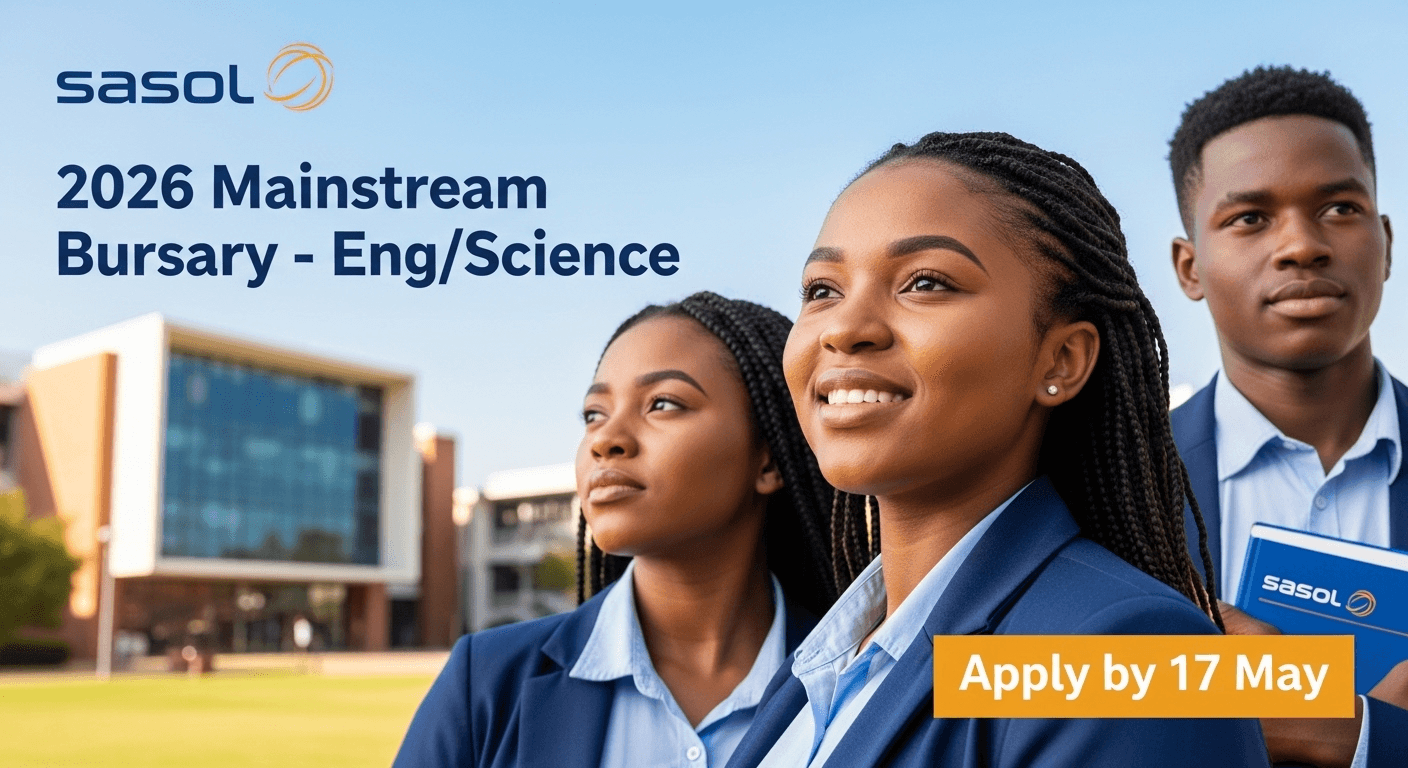

If you’re a high‑achieving student eyeing an engineering or science degree, the Sasol South African Mainstream Bursary Programme 2026 could be the ticket to a fully funded university education and a clear path into a career in the energy and industrial sector.
What Is the Sasol Mainstream Bursary Programme?
The Sasol bursary is a private‑sector scholarship that covers the full cost of a degree in a field that South Africa needs for its energy transition and industrial future. It goes beyond tuition – you also receive a living stipend, accommodation support, textbooks and structured career mentoring. Once you graduate, you’re invited to join Sasol’s Graduate Development pipeline, giving you a direct route into the company.
Who Should Apply?
To qualify you must:
- Be a South African citizen.
- Be under 30 years old.
- Be accepted or planning to apply to a recognised South African university.
- Plan to study full‑time.
- Apply for an approved engineering or science degree.
- Show strong academic results.
- Submit only one application.
- Provide accurate information throughout the process.
- Have Mathematics (not Mathematical Literacy) in your records.
Note: Distance‑learning institutions such as UNISA are not eligible, and diploma programmes are not funded.
What You Gain
The bursary covers:
- Full tuition fees.
- Accommodation support.
- Prescribed textbooks.
- Monthly stipend.
- Structured academic support.
- Mentorship from technical experts.
- Career development exposure.
- Direct access to Sasol’s Graduate Development Programme after graduation.
Because the scholarship is fully funded, you can focus on learning and on building industry‑relevant skills instead of worrying about costs.
Eligible Study Fields
Sasol funds only degree‑level qualifications (not diplomas). You can apply for undergraduate or postgraduate studies in:
Undergraduate Engineering and Science Degrees
- Chemical Engineering
- Civil Engineering
- Electrical Engineering
- Electronic Engineering
- Industrial Engineering
- Mechanical Engineering
- Mining Engineering
- Metallurgical Engineering
- Chemistry (to Honours level)
- Geology (to Honours level)
- Data Science (Computer Science)
- Data Science (Mathematics)
- Data Science (Statistics)
- Data Science (Operations Research)
- Mine Surveying (B.Eng Tech.) at Universities of Technology
Postgraduate Research Fields
Postgraduate bursaries focus on sustainability and the energy transition, with specialisations such as:
- Chemical Engineering: Fluid dynamics, Mathematical modelling, Process modelling, Reactor technology, Separation technology, Thermodynamics.
- Chemistry: Catalysis, Polymer science, Analytical chemistry, Environmental chemistry, Air dispersion modelling, Water and waste sustainability research.
- Data Science: Applied mathematics, Statistics.
- Cyber Security.
Workback Obligation
The bursary includes a workback agreement: after you finish your studies you’ll work for Sasol for a period equal to the duration of your bursary support. This gives you guaranteed workplace exposure, professional experience and a stable career path – but only if you’re ready to join Sasol’s technical environment.
How to Apply – Step by Step
- Gather your documents:
- South African ID.
- Academic transcripts.
- Grade 11 results (if you’re a matric student).
- Proof of university application or acceptance.
- Updated CV.
- Motivation letter (recommended).
- Go online to Sasol’s official bursary portal: https://www.sasolbursaries.com/welcome/
- Fill in the application form completely – missing fields or incorrect information will lead to disqualification.
- Upload your documents.
- Submit before the deadline on 17 May.
- If you encounter technical issues, contact Berlyne Rasool at 086 010 6235 or berlyne.rasool@adcorpgroup.com.
What to Expect in the Selection Process
Sasol’s selection is competitive. Even if you meet the minimum criteria, the company also considers:
- Academic performance (especially your most recent year).
- Alignment with scarce‑skills demand.
- Business needs.
- Future technical pipeline planning.
- For postgraduates, relevance to sustainability research.
Shortlisting is based on the previous academic year’s results. For example, Grade‑12 applicants must submit Grade 11 results.
Practical Tips to Boost Your Chances
- Apply as early as possible; late applications are rejected.
- Double‑check all information for accuracy.
- Keep your Mathematics grades strong.
- Choose a scarce‑skill field that aligns with Sasol’s focus.
- Prepare for interviews – treat it like a job interview.
- Consider applying for multiple bursaries (e.g., EWSETA, Mining SETA, engineering faculty scholarships) to widen your options.
Frequently Asked Questions
- Can I apply if I’m still in Grade 12? Yes. Use your Grade 11 results. Final selection will be conditional on your matric performance.
- Does Sasol accept Mathematical Literacy? No. Pure Mathematics is required.
- Can I study through UNISA? No – the bursary only supports full‑time university study.
- Are diploma programmes funded? No – only degree‑level qualifications are funded.
- Is there guaranteed employment after graduation? There is a workback agreement, so graduates usually join Sasol’s Graduate Development pipeline upon successful completion.
Apply Today – Deadline: 17 May 2026
Ready to transform your academic journey into a career in engineering and science? Visit the official application page now: Sasol South African Mainstream Bursary Programme 2026. Good luck, and take the first step toward a fully funded future.