
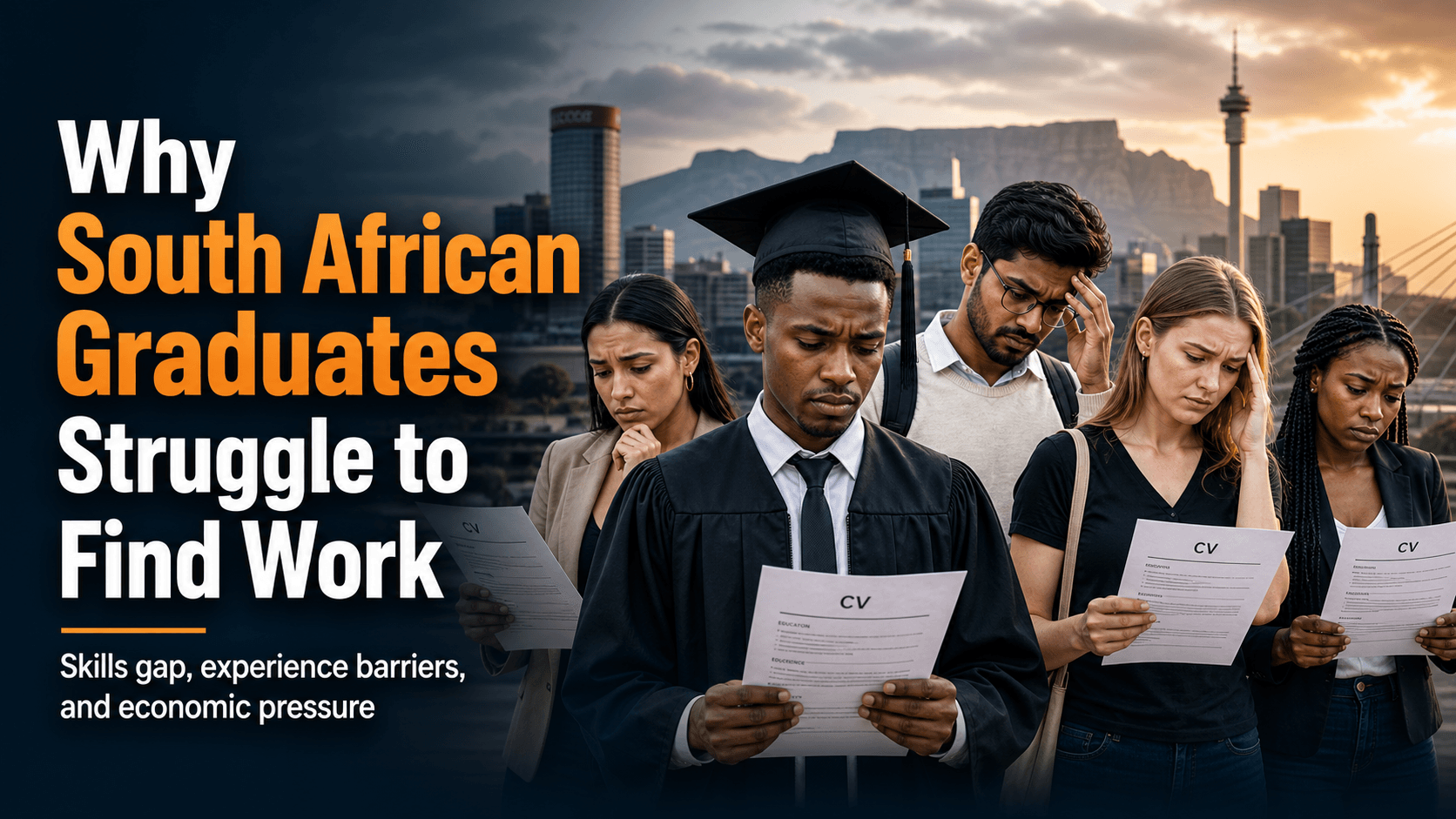

Every year, thousands of South African graduates finish their studies and expect their careers to begin. For many, the reality is very different. Months pass. Applications go unanswered. Rejection becomes routine. If this sounds familiar, you are not alone — and it is not simply your fault. Understanding why this happens is the first step toward changing it. Graduate unemployment in South Africa is one of the most serious challenges facing young people today, and it is getting harder to ignore.
The Real Problem: A Qualification Is Not the Same as Being Employable
Many students grow up believing that finishing a degree or diploma is the key to getting a job. That belief is understandable, but it is no longer entirely true.
Employers still care about qualifications. But they also care about much more. Today, companies want graduates who can communicate clearly, solve problems, use digital tools, and adapt quickly. A certificate alone does not prove any of those things.
This does not mean studying was a waste of time. It means the job market has shifted, and graduates need to shift with it.
Quick Overview
| Topic | Graduate unemployment in South Africa |
|---|---|
| Key Challenge | Too many graduates competing for limited opportunities |
| Biggest Barriers | Lack of experience, skills mismatch, weak job-search strategy |
| Most Affected | First-time job seekers and unemployed youth |
| Common Mistake | Applying randomly without improving employability |
| Important Advice | Build experience, practical skills, and professional visibility |
Why So Many Graduates Are Struggling Right Now
South Africa has one of the highest youth unemployment rates in the world. Universities, TVET colleges, and SETA-funded programmes release thousands of qualified candidates each year. At the same time, companies are advertising far fewer entry-level positions than before.
The result is intense competition. Employers have more choices than ever, and graduates who are not well-prepared often get passed over — not because they are not smart, but because others appear more ready.
Repeated rejection is painful. Many graduates start to doubt themselves. But the problem is usually bigger than any one person. Knowing that helps you focus on what you can actually change.
Reason 1: No Work Experience
This is the most common barrier graduates face. Many job listings ask for one to three years of experience, even for entry-level roles. For someone applying for their first job, that requirement feels impossible to meet.
The cycle is frustrating: you need experience to get a job, but you need a job to get experience. Employers ask for experience because it reduces their risk. They want someone who already understands how a workplace functions, needs less training, and can contribute quickly.
Graduates who completed internships, learnerships, volunteer work, or part-time jobs during their studies often have an advantage here. If you have not done any of those yet, that is your most important starting point now.
Reason 2: Your Qualification May Not Match What the Market Needs
Some fields produce more graduates than there are jobs available. General business qualifications, some humanities programmes, and certain administrative fields are highly competitive. Meanwhile, industries like engineering, cybersecurity, data analysis, healthcare, and renewable energy are actively struggling to find enough skilled workers.
This does not mean your qualification has no value. It means you may need to research where the real demand is and think about whether additional certifications or skills could help you enter a different part of the market.
Reason 3: Weak Job Search Strategy
Many graduates send the same CV to dozens of companies and wait. That approach rarely works. Recruiters notice generic applications immediately. Poor grammar, unprofessional email addresses, and missing documents can remove you from consideration before anyone has read your CV properly.
Applying for hundreds of jobs without customising your application is one of the most common mistakes young job seekers make. Quality matters far more than quantity. One well-prepared, tailored application is more effective than fifty generic ones.
Reason 4: Limited Professional Networks
Many job opportunities are never publicly advertised. They are shared through internal referrals, LinkedIn connections, former lecturers, and professional contacts. Graduates without any professional network often miss out on these hidden opportunities entirely.
This does not mean jobs are only given to people with connections. It means that being visible and building relationships genuinely improves your chances. Attending industry events, joining professional groups, and staying in contact with lecturers and supervisors can open doors you did not know existed.
Reason 5: Missing Digital Skills
Even jobs that have nothing to do with IT now require digital competence. Employers expect graduates to be comfortable with Microsoft Excel, email communication, online systems, spreadsheets, and virtual collaboration tools. Many also look for LinkedIn presence and basic AI literacy.
Graduates who cannot demonstrate these skills are at a growing disadvantage, even in administrative and junior roles. Free online courses can help you close this gap relatively quickly.
Reason 6: Expecting Too Much Too Soon
Some graduates turn down opportunities because the salary is too low or the role seems too junior. That is understandable, but it can slow down your career significantly.
Most successful professionals started in entry-level or temporary roles. Contract work, learnerships, and internships often lead to permanent employment. They also build the experience and networks that open better doors later. Staying open to smaller starting points is not giving up — it is being strategic.
Reason 7: South Africa’s Broader Economic Challenges
Graduate unemployment is also tied to factors outside your control. Many companies are reducing their hiring, freezing vacancies, automating tasks, or cutting costs. Both the public and private sectors are affected by economic uncertainty.
This means that even highly qualified graduates may struggle during difficult economic periods. Knowing this will not fix the economy, but it can help you manage the emotional weight of rejection more honestly.
Reason 8: Interview Skills Need Work
A strong CV gets you an interview. What happens in that room often decides everything else. Many graduates who perform well academically become nervous, unclear, or flat during interviews. They struggle to explain their qualifications in practical terms or fail to show confidence in how they communicate.
Employers assess your personality, professionalism, problem-solving ability, and communication — not just your results. Practising interview answers, researching the company beforehand, and preparing examples of how you have handled challenges can make a significant difference.
Reason 9: Applying Only for the Most Popular Jobs
Government jobs, banking, large corporate graduate programmes, HR, and administration roles attract enormous numbers of applicants. Competition in these areas is fierce. Many graduates apply only in these spaces and experience repeated rejection.
Smaller businesses, technical industries, non-profit organisations, and less glamorous sectors often struggle to attract applicants. Graduates who are willing to look beyond the obvious options sometimes find much better odds of success.
Reason 10: No Career Plan
Some students finish their qualifications without ever researching what the labour market actually needs. They do not know which skills are scarce, which industries are growing, or what employers in their field typically expect from new hires.
Career planning works best when it starts before graduation. But if you have already graduated, starting now is still far better than not starting at all. Research scarce skills, identify gaps in your profile, and make a plan to close them step by step.
What Employers Actually Want in 2026
Modern employers increasingly prioritise candidates who can show they are adaptable, reliable, and easy to work with. Beyond qualifications, they look for communication skills, work ethic, technical ability, teamwork, and initiative.
Practical ability is often valued more than theoretical knowledge. Graduates who can demonstrate what they have done — not just what they studied — stand out in a competitive field.
How You Can Improve Your Chances
Build Practical Experience
Look for learnerships, internships, volunteer work, community projects, freelance opportunities, or job shadowing. Even unpaid experience builds your CV and your confidence. It also gives you real examples to talk about in interviews.
Improve Your Digital Skills
Focus on Microsoft Excel, PowerPoint, Google Workspace, basic data analysis, LinkedIn, AI tools, and professional email writing. Many free courses are available online through platforms like Coursera, Google, and Microsoft Learn.
Customise Every Application
Read each job description carefully. Adjust your CV to highlight the most relevant experience. Write a cover letter that speaks directly to what the employer is asking for. Use keywords from the job posting. Never send a generic application.
Create and Maintain a LinkedIn Profile
A professional LinkedIn profile increases your visibility to recruiters and builds credibility. Many employers review online profiles before calling candidates in for interviews. Include your qualifications, skills, any experience, and a professional photo.
Stay Open to Entry-Level and Temporary Work
Temporary jobs, contract positions, and junior roles are not failures. They are starting points. Many people who are now in senior positions began exactly this way. Entry-level work builds experience, expands your network, and can lead to permanent employment.
The Emotional Side of Unemployment
Unemployment is not just a practical problem. It affects your mental health too. Many graduates experience anxiety, loss of confidence, family pressure, and financial stress after months of rejection.
It is important to understand that struggling to find work does not mean you have failed. South Africa’s labour market is genuinely difficult, and millions of young people are navigating the same challenges. Be patient with yourself while continuing to take small, consistent steps forward.
Comparing your progress to others rarely helps. Career timelines are different for everyone. Your task is to keep moving, keep improving, and keep applying.
The Bottom Line
Employment is not a destination you arrive at after graduation. It is something you build through consistent effort, smart strategy, and a willingness to grow. Graduates who understand this — and who invest in practical skills, professional visibility, and career planning — give themselves the best possible chance in a tough market.
Start with what you can control today. Update your CV. Apply for one internship or learnership. Complete one short online course. Build one new professional connection. Small steps, taken consistently, add up over time.
Frequently Asked Questions
- Does having a degree guarantee employment?
- No. Qualifications improve your options, but employers also look for experience, practical skills, and work readiness.
- Which graduates are most likely to struggle finding work?
- Graduates without any work experience, digital skills, or practical exposure often face the greatest challenges.
- Are internships really important?
- Yes. Internships provide workplace exposure and measurably improve employability for most graduates.
- Can TVET graduates also struggle with unemployment?
- Yes. Both university and TVET graduates can face employment challenges, depending on industry demand and individual skills levels.
- Should graduates accept temporary jobs?
- In most cases, yes. Temporary work builds experience, expands networks, and often leads to more permanent opportunities.
- Is networking really that important?
- Yes. A significant number of job opportunities are found through professional relationships and referrals rather than public job boards.
