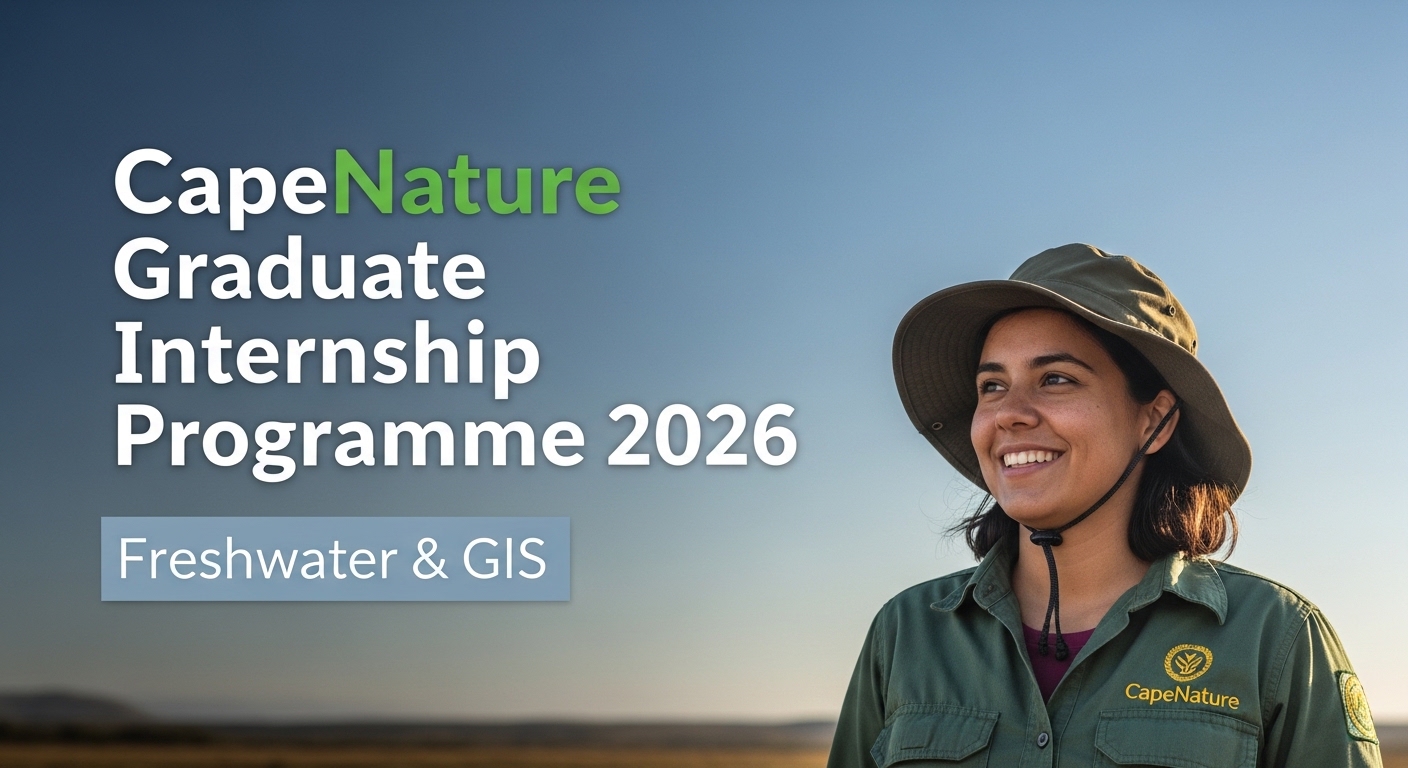
If you recently completed a degree in environmental science, freshwater ecology, geomatics, or a related natural science field, the CapeNature Graduate Internship Programme 2026 is one of the most valuable opportunities currently open in South Africa’s conservation sector. Two specialised placements are available, and the closing date is 22 April 2026. If this sounds like the right fit for you, now is the time to prepare your application.
What Is the CapeNature Graduate Internship Programme?
CapeNature is one of South Africa’s most respected conservation authorities. They manage nature reserves, protect biodiversity, monitor water resources, and support environmental planning across the Western Cape. This internship programme places qualified graduates directly inside these operations, not in general office roles.
The 2026 programme offers two distinct internship streams. Each one is technical, hands-on, and directly linked to real conservation work. These are not entry-level admin positions. They are graduate-level placements that build serious scientific and professional credibility.
Quick Overview
- Programme: CapeNature Graduate Internship Programme 2026
- Organisation: CapeNature
- Contract Type: Fixed-term graduate internship
- Citizenship: South African citizens only
- Employment Status: Must be currently unemployed
- Driver’s Licence: Required (EB08)
- Closing Date: 22 April 2026
- Application Method: Online via the CapeNature careers portal
Two internship streams are available:
- Ecological Technician – Freshwater (based at Jonkershoek Nature Reserve, Stellenbosch)
- GIS Technologist (based at the Cape Town Office)
Internship Stream 1: Ecological Technician – Freshwater
This placement is based at Jonkershoek Nature Reserve in Stellenbosch. You will work within CapeNature’s Integrated Catchments Sub-Directorate, supporting the protection of freshwater ecosystems across provincial nature reserves.
Freshwater systems such as rivers and wetlands are under serious pressure in South Africa. Pollution, invasive species, climate change, and water extraction are all contributing to their decline. The work you do in this internship directly supports South Africa’s legal obligations under the National Water Act (Act 36 of 1998).
Your responsibilities will cover three main areas:
Water Use Licence Compliance Auditing
You will help CapeNature determine which of its reserves already hold Water Use Licences, which qualify under General Authorisations, and which need new licence applications. This includes desktop compliance audits, identifying licensing gaps, and assisting with licence applications. This kind of regulatory experience is highly sought after in environmental compliance careers.
Freshwater Ecological Data Management
Raw field data and spreadsheets often need to be cleaned, validated, and organised before they can be used in scientific reports. You will assist with structuring faunal datasets, converting SASS scores into usable databases, organising wetland health assessments, and verifying freshwater monitoring records.
Freshwater Monitoring Fieldwork
You will participate in real ecological monitoring programmes. Tasks include coordinating freshwater monitoring activities, assisting with river assessments, supporting wetland condition monitoring, compiling technical site reports, and conducting literature reviews that feed into management plans.
Requirements: Ecological Technician – Freshwater
To qualify for this internship, you must meet all of the following:
- South African citizen
- Currently unemployed
- No criminal record
- BSc Honours or MSc in Freshwater Ecology, Aquatic Science, Conservation Biology, Environmental Science, or a closely related field
- Strong understanding of the National Water Act
- Practical experience with SASS5 biomonitoring (this is a standardised river health assessment method)
- Knowledge of wetland assessment protocols
- Freshwater fauna identification skills (this is an advantage, not a strict requirement)
- Valid EB08 driver’s licence
- Willingness to work in remote areas and conduct fieldwork
Apply for the Ecological Technician – Freshwater Internship here.
Internship Stream 2: GIS Technologist
This placement is based at CapeNature’s Cape Town Office. You will be part of the Biodiversity Capabilities Team, supporting the spatial data systems that help CapeNature make informed conservation decisions.
GIS stands for Geographic Information Systems. In simple terms, it means using computer software to create and analyse maps. In conservation, this is used for tracking wildfires, monitoring invasive plant species, planning biodiversity protection areas, and modelling water catchment strategies.
Your responsibilities will cover three main areas:
Spatial Dataset Compliance
You will help collect and verify spatial datasets, check mapping accuracy, and ensure that all GIS work meets organisational standards. You may also support mapping activities during wildfire response operations.
Historical Mapping Data Conversion
Much of CapeNature’s mapping is based on older, legacy datasets that need to be modernised and standardised. Tasks include standardising mapping datasets, supporting Fire Protection Associations, assisting municipalities with mapping alignment, and organising veld age, fire frequency, and invasive alien vegetation data.
Conservation Reporting Support
You will contribute to major provincial conservation reports, including the State of Conservation Report, the Annual Fire Report, the Annual Invasive Species Report, and the Catchment-to-Coast Strategy for 2027. These reports directly influence environmental planning decisions across the Western Cape.
Requirements: GIS Technologist
To qualify for this internship, you must meet all of the following:
- South African citizen
- Currently unemployed
- No criminal record
- Degree at NQF Level 7 or higher in Geomatics, Environmental Management, Conservation Science, Ecological Science, Biological Science, or Zoological Science
- Working knowledge of ArcGIS and QGIS (GIS software platforms)
- Experience with GPS systems, cartography, and spatial analysis
- Strong computer literacy
- Valid EB08 driver’s licence
Apply for the GIS Technologist Internship here.
What Both Internships Have in Common
Regardless of which stream you apply for, CapeNature will be looking for candidates who demonstrate the following:
- Strong organisation and attention to detail
- Ability to meet deadlines under pressure
- Ability to work both independently and as part of a team
- Scientific problem-solving approach
- Professional communication skills, both written and verbal
- Capability to produce GIS or ecological technical reports
Both internships also require a valid EB08 driver’s licence and involve fieldwork in remote locations. Make sure you are comfortable with this before applying.
What You Will Gain
From experience, graduates who secure placements with established conservation authorities like CapeNature come out with a level of technical credibility that is hard to build anywhere else. These internships offer you:
- Direct experience with South African environmental legislation and compliance
- Hands-on fieldwork in active nature reserves
- Real GIS mapping projects used in provincial planning
- Contribution to nationally significant conservation reports
- Professional references within one of the country’s leading conservation organisations
- A CV entry that demonstrates applied scientific experience, not just theoretical knowledge
Stipends are typically included with CapeNature graduate internships, aligned with provincial internship frameworks. Exact amounts are confirmed during the appointment process.
Documents You Need to Apply
Many applicants struggle at the document preparation stage. Get these ready before you start the online application:
- Updated CV with academic background and any relevant technical experience
- Certified copy of your ID
- Academic transcripts
- Qualification certificates
- Copy of your driver’s licence
- Any supporting technical certifications, such as SASS5 training or ArcGIS course completion
Late applications are not considered, so make sure everything is ready before the deadline.
How to Apply
- Decide which internship stream best matches your qualification and experience.
- Gather all required documents and ensure certified copies are clear and legible.
- Update your CV to highlight relevant technical skills, fieldwork, and software experience.
- Visit the official CapeNature careers portal to submit your application online.
- Submit before 22 April 2026. No late applications will be accepted.
Tips to Improve Your Chances
Environmental internships at organisations like CapeNature are highly competitive. The candidates who succeed are usually those who present their technical skills clearly and honestly. Here is what tends to make a strong application:
- For the Freshwater role: Highlight any SASS5 training certificates, ecological fieldwork participation, wetland or river assessments, and environmental legislation coursework. Include your honours thesis topic if it relates to aquatic or freshwater systems.
- For the GIS role: List every GIS software platform you have used, including ArcGIS and QGIS. Mention specific mapping projects, GPS field experience, and any biodiversity or fire mapping work you have done.
- For both roles: Include undergraduate research projects, biodiversity monitoring participation, and any postgraduate work. CapeNature values evidence-based scientific thinking.
- Apply early. Submitting well before the deadline shows professionalism and gives you time to fix any issues with your application.
- Be honest about your skill level. If you have used ArcGIS but are not advanced, say so. Overstating your skills in a technical interview will work against you.
Frequently Asked Questions
Is this internship paid?
CapeNature graduate internships typically include a stipend aligned with provincial frameworks. The exact amount is confirmed during appointment.
Can final-year students apply?
No. You must have already completed your qualification before applying.
Is GIS experience needed for the Freshwater internship?
No. However, SASS5 biomonitoring training is required for the Freshwater role.
Does fieldwork feature in both internships?
Yes. Both roles involve remote site visits, ecological monitoring, or conservation mapping activities. A willingness to work in the field is essential.
Can applicants from outside the Western Cape apply?
Yes, but relocation may be required. This is something to consider before applying.
Do both roles require postgraduate qualifications?
The Freshwater Ecological Technician role requires a BSc Honours or MSc. The GIS Technologist role requires a minimum NQF Level 7 degree.
Take the Next Step
If your qualification aligns with either of these internship streams, this is an opportunity worth pursuing seriously. CapeNature works at the forefront of conservation science in South Africa, and the experience you gain here will strengthen your career for years to come.
Prepare your documents now, update your CV to highlight your technical strengths, and submit your application before 22 April 2026. Do not wait until the last day.