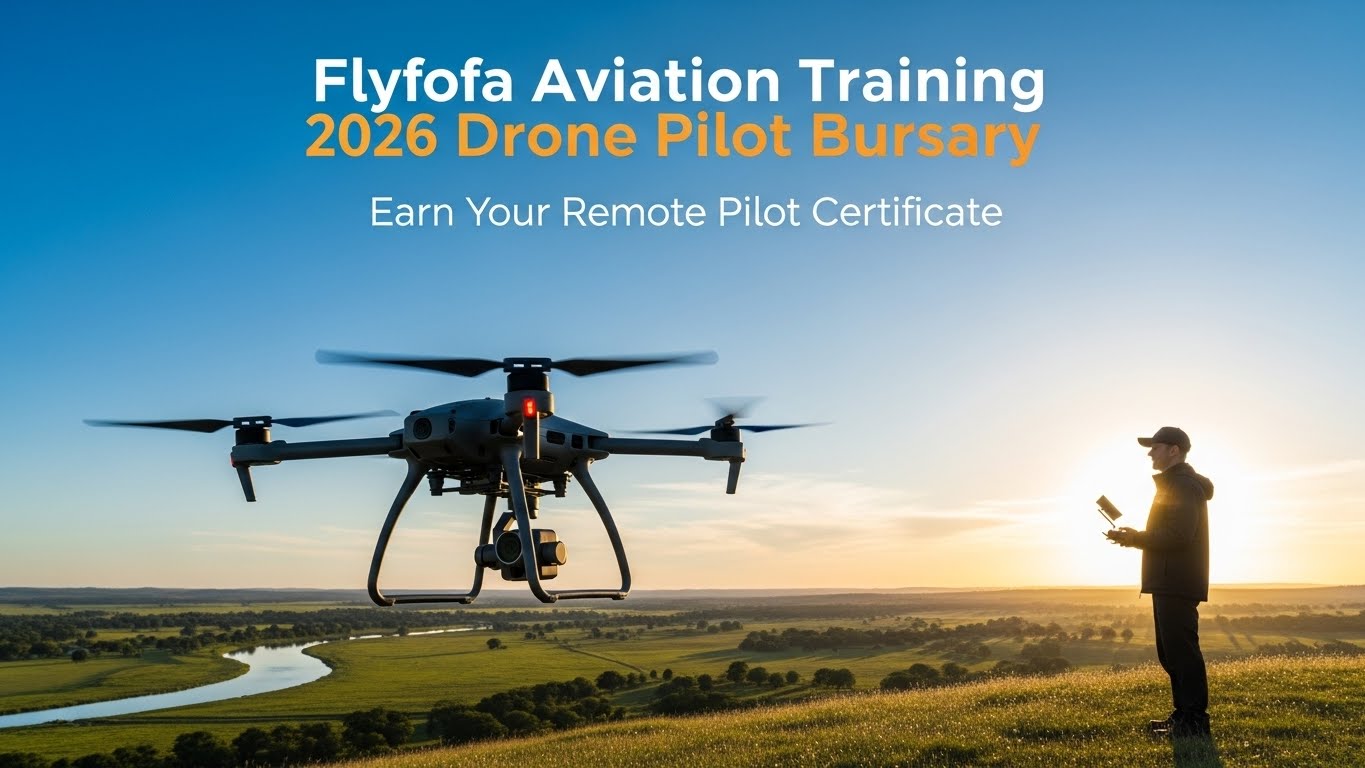
Flyfofa Aviation Training 2026 Drone Pilot Bursary – Earn Your Remote Pilot Certificate

Flyfofa Aviation Training invites suitably qualified applicants to apply for their Remote Pilot Certificate – Drone Pilot bursary vacancies. The closing date for applications is midnight on 15 January 2026.
Why This Bursary is a Game‑Changer for South African Teens
If you’re a 15‑year‑old in Gauteng who loves tech, flying, and the idea of a future job that keeps you on the cutting edge, this is a chance you can’t miss. Flyfofa Aviation Training, working with the National Skills Fund and the Department of Higher Education and Training, is offering a fully funded 12‑week course that will give you a Remote Pilot Certificate (RPC) – a key skill that’s in high demand across South Africa’s growing drone and aviation industry.
Quick Snapshot
| Item | Details |
|---|---|
| Program | Remote Pilot Certificate – Drone Pilot |
| Funding | 100 % covered – training, lodging, and a monthly stipend |
| Duration | 12 weeks (full‑time) |
| Who Can Apply | Gauteng residents, 18‑23 years old, South African citizens, with a Grade 12 pass from a Quintile 1‑3 school or a SASSA Child Grant recipient |
| Closing Date | Midnight, 15 January 2026 |
| Application Code | RPAS2026 |
About Flyfofa Aviation Training
Flyfofa is a respected South African school that teaches you everything about unmanned aircraft (drones). Their courses follow the South African Civil Aviation Authority (SACAA) rules, so you’ll finish with a legitimate certification that employers will recognize.
Key features of the program:
- A mix of classroom lessons and real‑flight practice
- Exams and tests inside and outside the classroom
- Experienced teachers who know the latest safety and compliance standards
- Hands‑on experience with real drones – not just simulations
When you finish, you’ll hold more than a certificate – you’ll have the know‑how to fly, plan routes, read weather, and handle emergency situations.
What You’ll Learn
- Drone rules and air law – understand the legal framework that keeps us all safe.
- Safe flying and risk control – learn how to avoid accidents and protect people.
- Drone systems – know what each part does and how to troubleshoot.
- Flight planning and navigation – chart your route and keep track of altitude.
- Weather basics – read the skies so you never fly into trouble.
- Emergency procedures – stay calm and act fast if something goes wrong.
- Hands‑on flight practice – spend time controlling drones in real conditions.
- SACAA exams – prove your knowledge and earn your certificate.
After the course, a qualified examiner will check your skills before you receive the official Remote Pilot Certificate.
Who Can Apply?
- South African citizens living in Gauteng
- Aged 18 to 23 – perfect for recent high‑school graduates
- Must have finished Grade 12 at a Quintile 1‑3 school in Gauteng or be a SASSA Child Grant holder
The goal is to give a chance to previously disadvantaged youth, ensuring equal access to high‑paying, tech‑focused careers.
Eligibility Checklist
- South African citizen
- 18‑23 years old
- Living in Gauteng
- Matriculated at a Quintile 1‑3 school in Gauteng
- Level 5 in English
- Level 4 in Mathematics or Level 5 in Mathematical Literacy
- Willing to undergo an aviation medical exam
- Good communication and decision‑making skills
- Able to multitask and coordinate hand‑eye movements
- Safety‑first mindset and open to learning
All items must be checked – missing one may disqualify you.
How to Apply
- Open the online form: https://docs.google.com/forms/d/e/1FAIpQLScVbLrz13ESIy89dR34cKWcYtDcEg9UEFIwnoZ7yQSVgDBLgw/viewform
- Pick Remote Pilot Certificate – Drone Pilot from the drop‑down.
- Enter the application code: RPAS2026
- Fill in the form carefully.
- Upload the required documents:
- A certified copy of your South African ID
- Proof of where you live
- Your Grade 12 certificate or results statement
Important: No late or incomplete applications will be accepted. Make sure every field is finished and every file is clear before you hit submit.
The Selection Process
- Pre‑screening – quick checks for basic eligibility.
- Personality test – to see if you’re a good fit for the aviation world.
- Medical exam – a standard aviation health check.
- Panel interview – discuss your interest, goals, and skills.
If you pass all four stages, you’ll get a spot in the 12‑week program.
How to Get the Most From This Opportunity
- Start your preparation early – use December to study basics and get your documents ready.
- Focus on safety – understand that drones need careful handling.
- Keep your documents official – always use certified copies.
- Explore related skills – e.g., basic coding, GIS, or entrepreneurship – to boost your career prospects.
Remember, a certificate alone isn’t enough. Combine it with hard work, discipline, and a clear goal for your future job.
Career Paths After Your Certificate
Entry‑Level Roles
- Junior Drone Pilot
- Drone Operations Assistant
- Surveying Assistant
- Security Drone Operator
Growth Opportunities
- Commercial Drone Pilot
- UAV Operations Manager
- Drone Instructor
- GIS & Mapping Specialist
- Film & Media Drone Operator
- Drone Business Owner
Many graduates go on to launch their own drone services, working with farms, construction sites, municipalities, and security companies.
Frequently Asked Questions
| Question | Answer |
|---|---|
| Is the bursary really fully funded? | Yes – training, housing, and a monthly stipend are all covered. |
| Do I need prior drone experience? | No – the course starts at a beginner level. |
| Can I apply if I live outside Gauteng? | No – this program is only for Gauteng residents. |
| What happens after the 12 weeks? | You’ll earn your Remote Pilot Certificate and can start job hunting or keep learning. |
| Who is the application code for? | Use RPAS2026 when filling out the form. |
Final Thoughts
This bursary is a real gateway into a tech‑powered future. With a Remote Pilot Certificate, you’ll open doors to a growing industry, earn a decent income, and gain skills that stay relevant for years.
Apply before midnight on 15 January 2026 – every moment counts. Good luck!