
If you have applied for an RDP house and are still waiting, you are not alone. Millions of South Africans are in the same position. What many people do not know is that the waiting is often caused by a detailed government verification process — and small mistakes in your records can add years to that wait.
Understanding how this process works could make a real difference to your application.
Quick Overview
| Programme | RDP / Government Housing Verification |
| Managed By | Provincial Human Settlements Departments |
| Main Purpose | Verify if applicants qualify for government housing |
| Key Checks | Income, identity, marital status, property ownership, dependants |
| Common Databases Used | DHA, SASSA, SARS, Deeds Office, UIF |
| Main Risk Factors | Incorrect information, duplicate applications, undeclared property ownership |
| Verification Outcome | Approved, pending, blocked, or rejected |
What Is RDP Housing?
RDP housing refers to government-subsidised homes provided to qualifying low-income South Africans. These homes are managed by the Department of Human Settlements through various subsidy programmes.
Although people still call them RDP houses, the programme has expanded well beyond the original Reconstruction and Development Programme. The homes are generally intended for:
- Low-income households
- Unemployed individuals
- Vulnerable families
- South African citizens who do not own property
- People living in informal settlements or unsafe conditions
Why Government Verifies Applicants
There are far more applications than there are available houses. Because of this, government departments run strict checks to make sure housing goes to the right people.
These checks are designed to prevent fraud, stop people from applying multiple times, and confirm that every applicant genuinely qualifies. Verification can also uncover problems such as applicants who already own property, earn above the income limit, or previously received a housing subsidy.
Which Departments Are Involved?
Several government departments work together during the verification process. Each one checks a different part of your record.
- Department of Human Settlements — Oversees housing subsidies and allocations.
- Department of Home Affairs (DHA) — Verifies your identity, citizenship, marital status, and family records.
- South African Revenue Service (SARS) — Checks your employment history, tax records, and income status.
- South African Social Security Agency (SASSA) — May confirm household vulnerability and income circumstances.
- Deeds Office — Checks whether you already own property anywhere in South Africa.
How the Verification Process Works
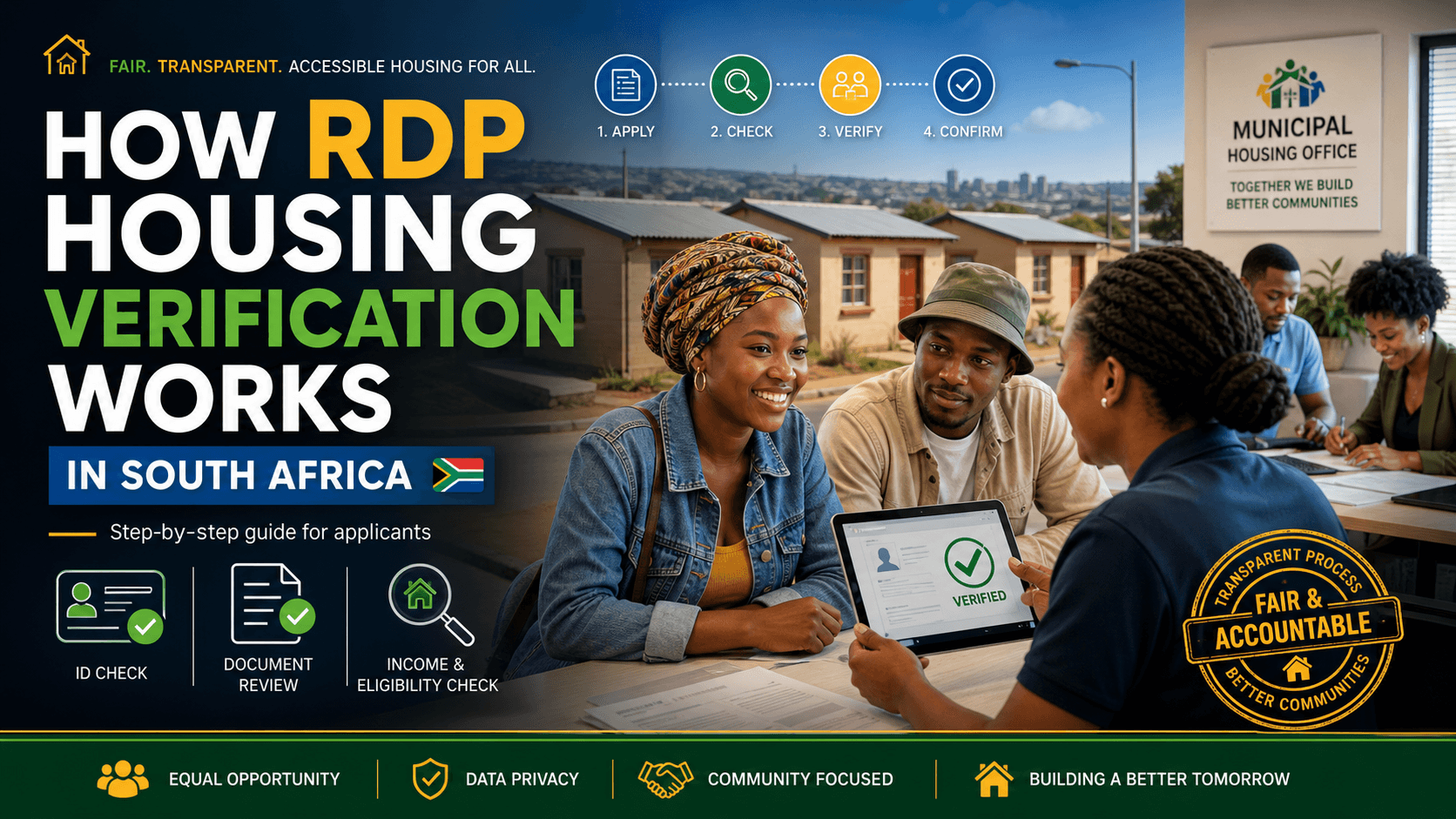
Government runs through several verification steps before making a decision on your application. Here is what each step involves.
Step 1: Identity Verification
The first check is your identity. Authorities confirm that your ID number is valid, that you are alive in the system, and that your name matches Home Affairs records. If there is a mismatch or error, your application may be blocked or delayed.
Common problems include wrong ID numbers, names that do not match across documents, duplicate identities, or a deceased status that was never corrected. This is why you should check your Home Affairs records before you apply.
Step 2: Citizenship Check
Government housing is mainly available to South African citizens and certain permanent residents. If the system cannot confirm your citizenship or legal residency, your application will not pass this step.
Step 3: Income Verification
This is one of the most important checks. Government housing is for low-income households, so authorities verify whether your income falls within the qualifying threshold. They may look at UIF records, SARS data, employer details, and salary information.
Problems can occur if your income was understated, if you recently started working, or if temporary earnings appear in government databases when you consider yourself unemployed.
Step 4: Property Ownership Checks
Authorities check the Deeds Office to see whether you own any property or have previously received a government housing subsidy. If you already own a home or have benefited from a subsidy before, you may be disqualified.
Many applicants are caught off guard by inherited or family-linked properties. Even if you did not buy the property yourself, your name appearing on the title deed can affect your application.
Step 5: Marital Status Verification
Your marital status affects how household income and property ownership are assessed. Government systems check whether you are married, divorced, widowed, or single.
Outdated Home Affairs records cause problems here. If a divorce was never updated, a spouse passed away but the record is still active, or marriage records contain errors, your application may be delayed.
Step 6: Dependants and Household Checks
Authorities may also look at how many people depend on you. This includes children, elderly dependants, and anyone with a disability in your household. This information can influence your housing priority, the type of unit you receive, and which subsidy category you fall under.
You may be asked to provide birth certificates, affidavits, proof of guardianship, or disability documentation to support this part of your application.
Step 7: Duplicate Application Detection
Government systems are designed to catch duplicate applications. This can happen when one person applies in multiple provinces, when the same ID is used more than once, or when family members submit applications with conflicting information. Duplicate applications trigger investigations and cause significant delays.
Why Some Applications Get Flagged
Your application can be flagged for reasons you may not even be aware of. Small spelling mistakes, an ID number with one digit wrong, or a name that differs between your ID and your qualification documents can all cause problems.
Other reasons include showing up as a property owner in the Deeds Office system, income records that contradict what you declared, a previous subsidy linked to you or your spouse, or patterns in your application that trigger a fraud investigation.
How Long Does Verification Take?
There is no fixed timeline. Verification can take months or several years, especially in high-demand provinces. Delays are often caused by housing project availability, provincial backlogs, database inconsistencies, manual investigations, land availability, and audits.
Many applications sit in a “pending” status for a long time simply because not all verification steps have been completed yet.
Why Some People Get Houses Faster
Certain factors can move an application up the priority list. These include age, disability status, vulnerability, emergency housing situations, and whether your area is part of an informal settlement upgrading programme. Some applicants also benefit from older, already-verified applications that were submitted years earlier.
What Happens After Verification
Once verification is complete, you may be approved, placed on a waiting list, flagged for further checks, or rejected. Being approved does not mean you will receive a house immediately. Actual allocation still depends on housing project completion and available budgets.
Can You Check Your Application Status?
In some provinces, you can check your status online or by visiting your local Human Settlements office. Your status may show as approved, pending, on the waiting list, subsidy approved, or not found.
Be cautious of unofficial websites that claim to offer housing approvals or status checks. Always use official government channels.
Common Mistakes to Avoid
Many applications are delayed because of avoidable errors. Here are the most common ones:
- Providing false information — Even small inaccuracies can disqualify your application or trigger an investigation.
- Using outdated or uncertified documents — Make sure all documents are certified, current, and consistent across departments.
- Failing to update personal details — Your phone number, address, marital status, and employment status should be kept up to date with all relevant departments.
- Ignoring requests for additional documents — If government contacts you for more information, respond promptly.
How Government Fights Housing Fraud
Housing fraud is taken seriously. Authorities now use digital verification systems, cross-department database matching, property ownership tracing, identity authentication, and housing audits to detect illegal house sales, fake beneficiaries, corrupt allocations, and duplicate subsidies.
The system is more thorough than it used to be, which means it is harder to slip through with incorrect or dishonest information.
What to Do If Your Application Has Problems
If your application is delayed or flagged, take these steps:
- Visit your local Human Settlements office and ask for an update.
- Check your Home Affairs records and correct any errors.
- Confirm that your personal details are accurate across all departments.
- Keep copies of every document you have submitted.
- Ask whether any additional documentation is required.
Never pay anyone who claims they can speed up your housing approval. No legitimate government official can sell or guarantee an RDP house in exchange for money. This is a scam.
Frequently Asked Questions
- Can I qualify if I am unemployed?
- Yes. Many government housing programmes are specifically designed for low-income and unemployed households.
- Can I apply if I already own land?
- This depends on the specific subsidy programme and the nature of your ownership. You should confirm this with your local Human Settlements office.
- Can married couples both apply separately?
- Usually, housing applications assess household circumstances jointly, not individually.
- Can my application be rejected years after I applied?
- Yes. Verification can uncover issues long after you first submitted your application.
- Does receiving a SASSA grant automatically qualify me for an RDP house?
- No. SASSA grants and government housing programmes are completely separate systems.
- What if my ID details are incorrect?
- Visit your nearest Home Affairs office as soon as possible to correct your records. This is one of the most important things you can do to protect your application.
Final Thoughts
Government verification for RDP housing is more detailed than most people expect. It involves multiple departments, digital databases, and cross-checks that can take a long time to complete. The process exists to make sure that housing reaches South Africans who truly qualify.
The best thing you can do right now is make sure your personal information is accurate everywhere. Check your Home Affairs records. Keep your contact details updated. Hold on to every reference number and document you have submitted. And stay away from anyone promising to sell you a shortcut.
For many families, getting these basics right is the most important step toward eventually receiving a home.