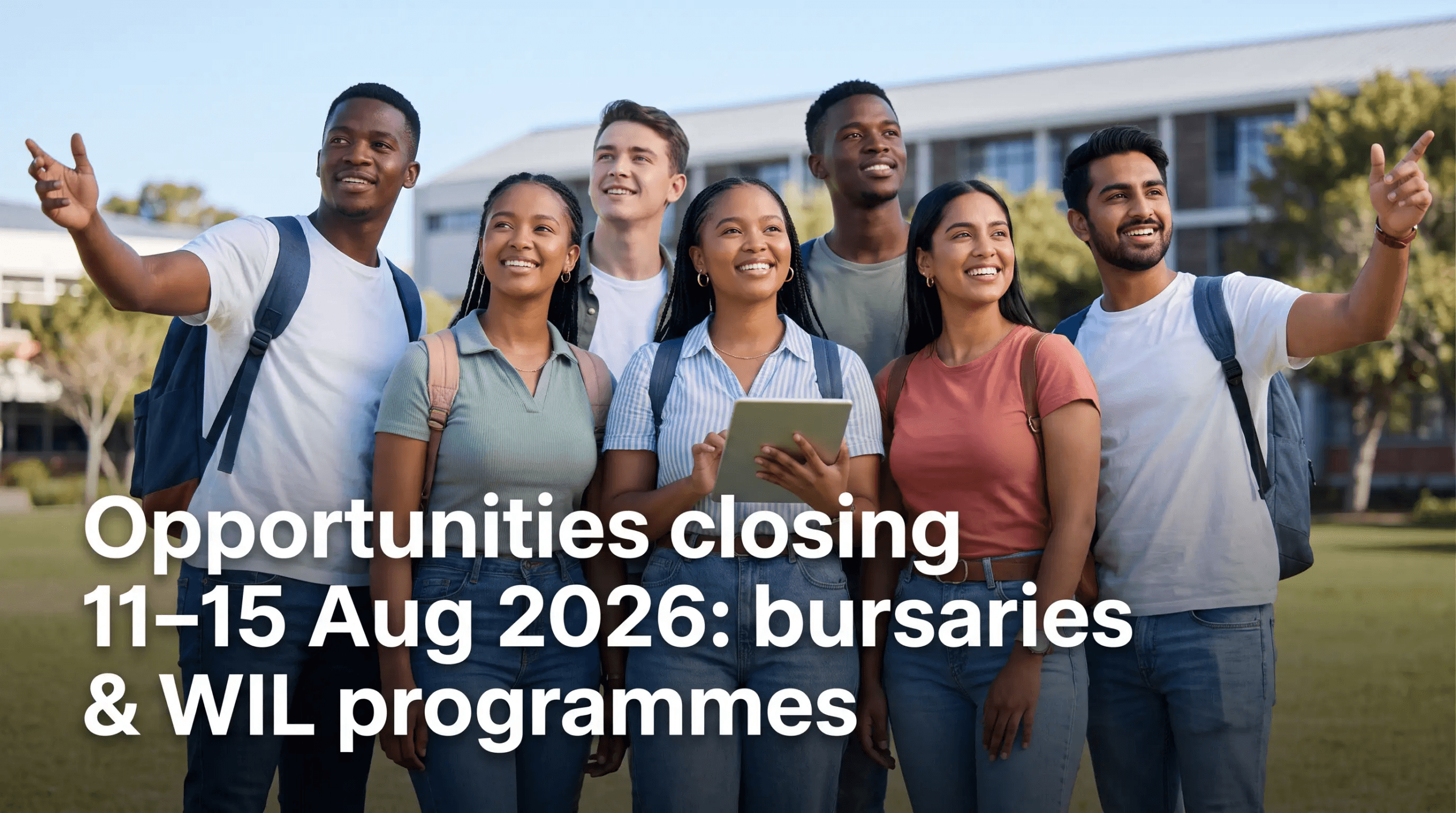

If you have been putting off your applications, now is the time to act. Opportunities such as learnerships, Work Integrated Learning (WIL) programmes, internships, skills courses and bursaries are closing this week, and missing the deadline could mean losing a chance at real workplace exposure. For more information about programmes that are listed by SETA SA, read on.
Quick overview – 10 opportunities closing between 11 and 15 August 2026
- Transnet TVET Non‑Technical WIL Programme 2026 – 11 August 2026
- Capitec External Bursary Programme 2027 – 12 August 2026 (14:00)
- SASSA TVET WIL Programme 2026 – 13 August 2026
- Bidvest Tank Terminals WIL Programme 2026 – 14 August 2026
- Gauteng Department of e‑Government WIL Programme 2026 – 14 August 2026
- PSiRA Women Drone Pilot Skills Programme Phase 2 – 14 August 2026
- DFFE EPWP Youth Graduate Project 2026/2027 – 14 August 2026 (16:00)
- PMG Mining Internship Programme 2026 – 14 August 2026
- PMG Mining Bursary Programme 2027 – 14 August 2026
- MICT SETA & mLab Internet of Things Short Skills Programme 2026 – 15 August 2026
1. Transnet TVET Non‑Technical Work Integrated Learning Programme 2026
What the opportunity is
An 18‑month WIL placement that gives TVET College students practical experience in non‑technical roles across South Africa.
Who can apply
- Current TVET College student who has finished the theoretical part of a qualification
- South African citizen, ID number required
- Matric certificate and academic record
- WIL letter from your college
- Preference is given to persons living with a disability
What you gain
- Real workplace exposure needed to complete your qualification
- Potential stipend (details provided by Transnet during onboarding)
- Networking with a national rail and logistics operator
How to apply (step‑by‑step)
- Download the official application form from the Transnet careers page.
- Prepare an updated CV, copy of ID, Matric certificate, latest academic transcript and your college’s WIL letter.
- Combine all documents into a single PDF named
Transnet_WIL_YourName.pdf. - Upload the PDF to the Transnet online portal before 23:59 on 11 August 2026.
- Submit and keep a screenshot of the confirmation page.
Tips to improve your chances
- Highlight any volunteer work or short projects that demonstrate reliability.
- Use a clear, chronological CV – keep it under two pages.
- Proof‑read every document for spelling errors.
- If you have a disability, attach any supporting medical documentation to claim the preference.
2. Capitec External Bursary Programme 2027
What the opportunity is
A bursary that funds full‑time study for the 2027 academic year. The amount and duration are set by Capitec Bank.
Who can apply
- South African citizen, aged 18‑35
- Accepted for full‑time study at a recognised South African university or college for 2027
- Minimum academic requirements as set by Capitec (usually a good Matric result)
What you gain
- Financial coverage of tuition, textbooks and living expenses (exact figure disclosed after selection)
- Possible internship placement with Capitec after graduation
How to apply (step‑by‑step)
- Visit the Capitec bursary portal (official link from the bank’s website).
- Create an account and select “External Bursary 2027”.
- Upload a CV, certified copies of ID, Matric certificate and acceptance letter from your chosen institution.
- Complete the short personal statement (max 300 words) explaining why you need the bursary.
- Submit before 14:00 on 12 August 2026. Aim to finish at least three hours early.
Tips to improve your chances
- Write a concise, honest personal statement – avoid generic phrases.
- Ensure all PDFs are under the maximum file size indicated.
- Check your internet connection before uploading large files.
- Save a copy of the confirmation email for future reference.
3. SASSA TVET Work Integrated Learning Programme 2026
What the opportunity is
An 18‑month WIL placement in the Eastern Cape, offered by the South African Social Security Agency (SASSA).
Who can apply
- TVET student holding an N6 national certificate or statement of results
- South African citizen, aged 18‑35
- Ready to start the placement immediately after acceptance
What you gain
- Monthly stipend of R5 860,25
- Practical experience in a public‑sector environment
- Potential future employment with SASSA
How to apply (step‑by‑step)
- Access the SASSA WIL application page (official link provided on the SASSA website).
- Complete the online registration form and upload a CV, ID copy, N6 certificate, and academic transcript.
- Attach a letter from your TVET college confirming your eligibility for a WIL placement.
- Submit before the close of business on 13 August 2026.
Tips to improve your chances
- Emphasise any previous community or public‑service work.
- Make sure the stipend amount is clearly shown on your application proof.
- Double‑check that your N6 certificate is scanned clearly.
4. Bidvest Tank Terminals Work Integrated Learning Programme 2026
What the opportunity is
An 18‑month WIL placement in Kempton Park, Gauteng, focused on HR, Business Administration and Environmental Management.
Who can apply
- TVET students who have completed the theoretical component of a diploma
- No prior work experience required
- South African citizen with valid ID
What you gain
- Full‑time exposure to a large logistics operation
- Monthly stipend (as detailed on the Bidvest portal)
- Opportunity to secure a permanent role after the programme
How to apply (step‑by‑step)
- Go to the Bidvest careers site and locate the “Tank Terminals WIL 2026” posting.
- Register, then upload a CV, ID, Matric certificate, academic transcript and the WIL letter from your college.
- Submit your application before 23:59 on 14 August 2026.
Tips to improve your chances
- Tailor your CV to highlight any HR, admin or environmental coursework.
- Use bullet points to list relevant projects or group work.
- Proofread the WIL letter – it must be signed and dated.
5. Gauteng Department of e‑Government Work Integrated Learning Programme 2026
What the opportunity is
A WIL placement within the Gauteng e‑Government department, offering exposure to public‑sector ICT projects.
Who can apply
- South African citizen, aged 18‑35
- Current tertiary student (or recent graduate) with a recognised ICT or related qualification
- Preference for persons with a disability
- Required documents: Z83 form, CV, academic transcript, confirmation letter from your institution, and ID copy
What you gain
- Hands‑on experience in digital government services
- Potential stipend (as stated in the official advert)
- Networking with Gauteng’s ICT professionals
How to apply (step‑by‑step)
- Download the Z83 form from the Gauteng Department of Economic Development website.
- Complete the form and scan it as a PDF.
- Upload the PDF together with your CV, ID, transcript and institutional confirmation to the department’s application portal.
- Submit before the deadline on 14 August 2026.
Tips to improve your chances
- Check every required field on the Z83 form – an incomplete form will be rejected.
- Label each document clearly (e.g., “Z83_JohnDoe.pdf”).
- Confirm that your institution’s letter is on official letterhead.
6. PSiRA Women Drone Pilot Skills Programme Phase 2
What the opportunity is
A six‑to‑eight‑week skills programme that trains women for drone‑pilot roles in the security sector.
Who can apply
- South African women, 18 years or older
- No formal qualifications required
- Must be able to travel to the training venue (location varies)
What you gain
- Hands‑on drone‑operation training delivered by an aviation provider
- Accommodation and transport covered during the training period
- No stipend, but the certificate can open doors in security, mining, agriculture and surveying
How to apply (step‑by‑step)
- Visit the PSiRA official programme page (link provided on the PSiRA website).
- Complete the online registration form and upload a certified copy of your ID.
- Submit before 23:59 on 14 August 2026.
Tips to improve your chances
- Explain briefly why you are interested in drone technology in the optional comment box.
- Ensure your contact details are correct – the programme will contact you directly.
7. DFFE EPWP Youth Graduate Project 2026/2027
What the opportunity is
A youth‑focused EPWP project offering 20 short‑term positions for recent graduates. The placement lasts about eight months.
Who can apply
- South African citizen, aged 18‑35
- Recent graduate (any discipline) with proof of qualification
- Unemployed at the time of application
- Must provide ID, certified qualifications, proof of residence and a detailed CV
What you gain
- Daily rate of R271,04 (paid monthly)
- Practical experience in the Department of Forestry, Fisheries and the Environment
- Potential to be considered for permanent roles
How to apply (step‑by‑step)
- Navigate to the DFFE EPWP recruitment portal (official link on the DFFE website).
- Fill in the online application, upload required documents and confirm your availability.
- Submit before 16:00 on 14 August 2026.
Tips to improve your chances
- Pay close attention to the time‑stamp – late submissions are not accepted.
- Include a concise cover letter that matches your qualification to the project’s focus areas (e.g., environmental monitoring).
8. PMG Mining Internship Programme 2026
What the opportunity is
A 12‑month paid internship in the Tsantsabane region (Northern Cape) for graduates in engineering fields.
Who can apply
- Unemployed South African graduate in Electrical or Industrial Engineering
- Preference for residents of the Northern Cape
- Valid South African ID and proof of qualification
What you gain
- Full‑time exposure to modern mining operations
- Stipend (as per PMG’s internship scale)
- Training in mining‑specific software and safety standards
How to apply (step‑by‑step)
- Visit the PMG Mining careers page and locate the “Internship 2026” vacancy.
- Upload a CV, copy of ID, engineering degree certificate and academic transcript.
- Submit before the close of business on 14 August 2026.
Tips to improve your chances
- Highlight any project work or internships that involved equipment maintenance, CAD or process optimisation.
- State your willingness to relocate to the Northern Cape.
9. PMG Mining Bursary Programme 2027
What the opportunity is
A bursary that funds full‑time study for the 2027 academic year for students entering mining‑related disciplines.
Who can apply
- South African student accepted for full‑time study at a recognised university or college
- Preference for applicants from the Tsantsabane region
- Must meet the academic criteria set by PMG (normally a minimum average of 60 % in Matric and relevant subjects)
What you gain
- Financial assistance covering tuition, books and a modest living allowance
- Potential future employment with PMG Mining after graduation
How to apply (step‑by‑step)
- Go to the PMG Mining bursary portal (official link on their website).
- Complete the application form and upload a CV, ID, Matric certificate, acceptance letter from your institution and a short motivation letter.
- Submit before 23:59 on 14 August 2026.
Tips to improve your chances
- Emphasise any community or school projects related to mining, geology or engineering.
- Proof‑read your motivation letter for clarity and concision.
10. MICT SETA & mLab Internet of Things Short Skills Programme 2026
What the opportunity is
A three‑month short‑skills programme introducing participants to the Internet of Things (IoT). The training is based in Kimberley, Northern Cape.
Who can apply
- Unemployed South African with an NQF Level 5 qualification or higher
- Interest in technology, automation or data analytics
- Willingness to attend full‑time training for three months
What you gain
- Hands‑on IoT training – sensors, connectivity, data visualisation
- Monthly stipend (subject to funder eligibility)
- Skills applicable to smart agriculture, manufacturing, logistics, mining, smart‑city projects and more
How to apply (step‑by‑step)
- Visit the MICT SETA & mLab programme page (official link on the MICT SETA website).
- Fill out the online application, upload a CV, ID copy, NQF 5 certificate and proof of unemployment.
- Submit before 23:59 on 15 August 2026.
Tips to improve your chances
- Show any personal projects (e.g., Arduino, Raspberry Pi) in your CV.
- Explain how you plan to use IoT skills to address a problem in your community.
Which opportunity fits you best?
Don’t apply to every posting. First, check whether you meet the minimum eligibility. If you are a TVET N6 student needing practical experience, prioritize the Transnet, SASSA or Bidvest WIL programmes. Engineering graduates may find the PMG Mining internship most relevant. If you want to study in 2027, look at the Capitec or PMG bursaries. For tech‑savvy candidates, the mLab IoT programme could be a launchpad. Choose the programmes that match your qualifications and career goals, then focus on submitting strong, tailored applications.
Why you should not wait until the last day
A closing date is the absolute final day, not the recommended day to apply. Submitting early protects you from:
- Website outages or slow loading
- Internet connectivity problems
- Missing or incorrectly formatted documents
- Forgotten passwords or full email inboxes
- Portals that close at a specific hour (e.g., 14:00 or 16:00)
Whenever possible, aim to submit at least one day before the deadline.
Application checklist
Before you hit “send”, verify that you have:
- Updated CV
- South African ID (certified copy)
- Matric certificate (certified)
- Academic transcript or statement of results
- Qualification certificate (if applicable)
- Proof of residence (utility bill or lease)
- WIL or institutional letter (when required)
- Driver’s licence (if the posting asks for it)
- Z83 form (for certain government programmes)
Only attach the documents listed in the specific programme’s instructions.
Common mistakes to avoid
Applying without checking qualifications
Read the eligibility criteria carefully; an N6 HR qualification will not satisfy an engineering internship.
Sending a one‑size‑fits‑all CV
Tailor your CV to highlight the skills and coursework most relevant to each opportunity.
Waiting until the final hours
Submit early to avoid technical glitches.
Ignoring location preferences
Many programmes give priority to applicants from specific provinces or municipalities.
Paying anyone to “secure” a placement
Only use the official application portals linked on the employer’s website. Never pay for a job.
Not reading the original advertisement
SETA SA summaries are helpful, but always verify details on the official source before you apply.
Use the SETA SA platform to explore more opportunities
The SETA SA portal lets you browse accredited learnerships and skills‑development programmes across South Africa’s 21 SETAs. You can filter by sector – ICT, mining, finance, agriculture, construction, etc. – to find programmes that match your qualification and career aspirations.
Final advice
This week is deadline‑heavy. If you meet the criteria for any of the programmes above, start now:
- Pick the earliest closing opportunity.
- Read the full requirements.
- Gather and certify your documents.
- Complete the online application.
- Submit before the deadline.
- Move on to the next programme for which you also qualify.
Consistency is your biggest advantage. You can’t control the number of applicants, but you can control that your application is complete, accurate and submitted on time.
Frequently asked questions
Are all 10 opportunities learnerships?
No. The list includes WIL programmes, internships, skills programmes, EPWP projects and bursaries. Check the type before you apply.
Which opportunity closes first?
The Transnet TVET Non‑Technical WIL Programme, closing on 11 August 2026.
Are there opportunities for applicants with only Matric?
Some youth programmes accept Matric‑only applicants, but most WIL, internship and technical programmes require post‑school qualifications.
Can I apply for more than one programme?
Yes, as long as you meet each programme’s specific requirements and the provider does not forbid multiple applications.
Do all programmes pay a stipend?
No. Stipends vary. For example, the PSiRA Drone Pilot Skills Programme does not provide a stipend, though it covers accommodation and transport.
Do I need prior work experience?
Many of the listed programmes are designed for candidates with little or no work experience. Still, read each advert carefully.
What is the difference between a learnership and WIL?
A learnership combines formal study and workplace training toward a registered NQF outcome. WIL is usually a placement for students who have already completed the theoretical part of a qualification and need practical exposure.
Can TVET College students apply?
Yes. The Transnet, SASSA and Bidvest programmes specifically target qualifying TVET students.
What happens if I apply after the deadline?
Late applications are normally rejected. Submit early.
Where should I apply?
Follow the application instructions in the official employer or programme advertisement. Verify the URL on the employer’s official website before entering personal details.
Disclaimer
This article is an independent guide based on opportunities listed on SETA SA and information available from the official advertisements at the time of writing. SETA SA is not the employer, SETA, government department or selection authority for these programmes unless explicitly stated. Closing dates, requirements, locations and application procedures may change. Always verify the latest information through the official application source before submitting personal information or supporting documents. Never pay anyone who promises to secure a learnership, internship, bursary or job in exchange for money.
Editorial integrity
SETA SA researches, explains and publishes employment, education and skills‑development opportunities to help South African applicants understand them more easily. When an opportunity is described as a WIL programme, internship, bursary or short skills programme, we do not re‑label it as a learnership. Programme requirements, closing dates, stipends and application procedures should always be confirmed against the official employer or programme provider before you apply.